Capsules
Consider capsule size, fill weight and the receiving hopper arrangement.
For Capsules, Tablets, Softgel Capsules, Gummies & More
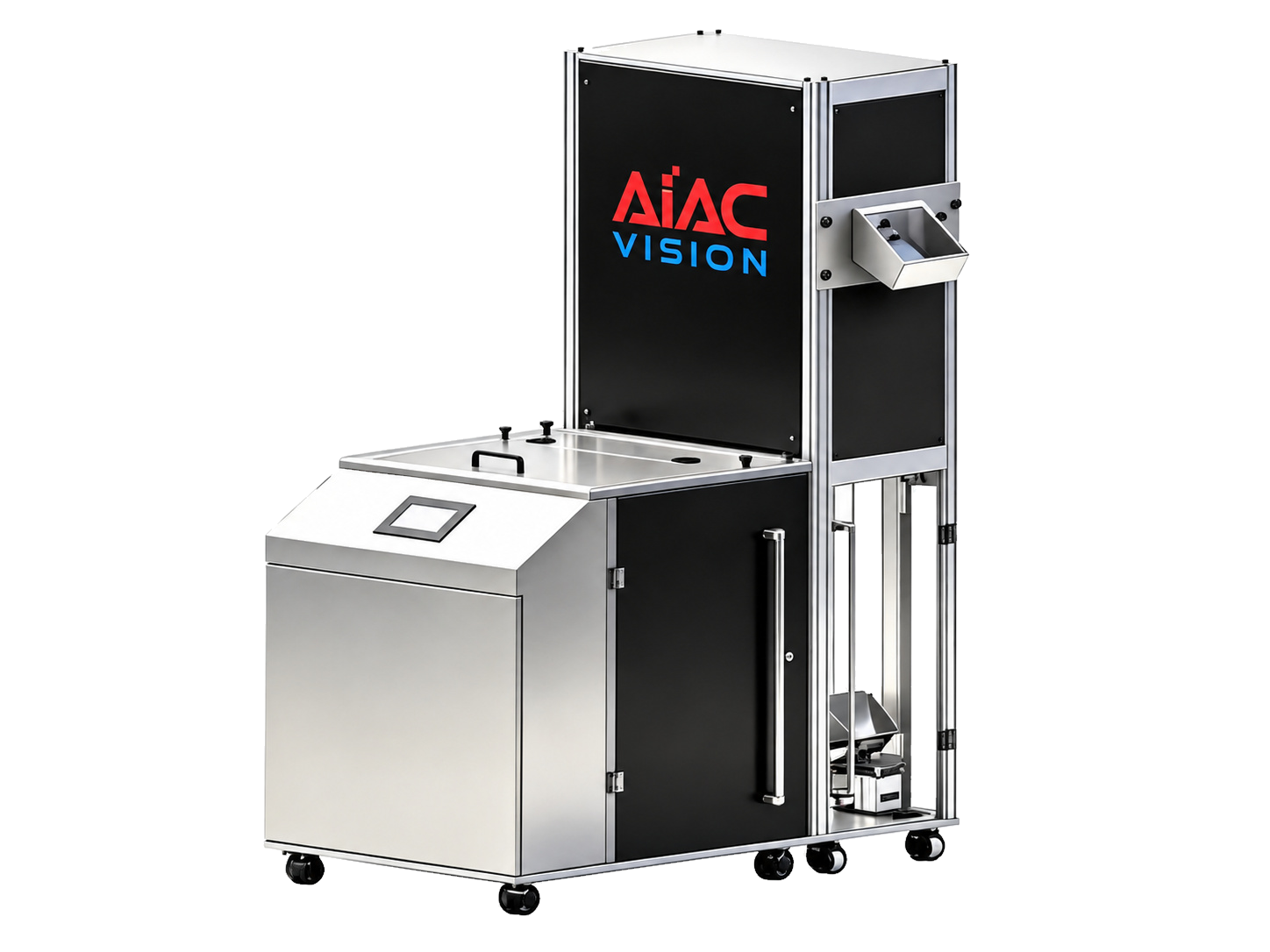
The AIACVISION LF-80 elevates products to downstream packaging lines or inspection equipment, reducing repeated manual lifting and loading. An optional 80 L hopper supports manual batch loading; inline installations can receive product directly from upstream equipment without this hopper.
Available as an independent product with its own power supply, it can supply AIACVISION systems or equipment from other manufacturers. Product characteristics, throughput, discharge height and equipment interfaces guide the feeding configuration.
Feed capsules, tablets, softgel capsules, gummies and other products with a configuration selected for their handling requirements.
Consider capsule size, fill weight and the receiving hopper arrangement.
Match the transfer to tablet shape, coating and susceptibility to chipping.
Account for surface condition, deformation sensitivity and discharge drop.
Review tackiness, sugar or oil coatings and product separation during feeding.
Other products: share dimensions, shape, surface condition and handling requirements for application evaluation.
Supply downstream packaging equipment, including counting and bottling or bagging applications. Match the outlet arrangement, delivery rate and controls to the receiving machine.
Feed vision inspection machines, sorters and other inspection equipment. The LF-80 can supply AIACVISION systems or third-party equipment with suitable infeed and control interfaces.
The LF-80 has an independent power supply and can be purchased for your own feeding application. Mechanical connections, receiving-hopper signals and start/stop coordination are matched to the downstream equipment.
Load through the optional 80 L hopper, or receive product directly from upstream equipment in an inline installation without this hopper.
The servo-controlled lift raises the product to the required feeding height.
Deliver product to the receiving equipment. With a compatible hopper-level interface, feeding starts and pauses according to demand.
Choose the 80 L hopper for manual batch loading and fewer refills. It can be omitted when the elevator is supplied directly by upstream equipment.
Standard lift height: 74.8 ± 3.9 in. Custom heights are available to suit the receiving equipment.
Coordinate feeding with the receiving hopper level through a compatible control interface.
Access routine feeding and lifting operations through the touchscreen controls.
Transfer product and separate loose dust during feeding where appropriate for the product.
Product-specific, replaceable screen plates support the selected screening application.
Review loading, discharge drop and receiving-hopper geometry for fragile tablets, softgels and gummies. Representative samples help assess product flow, sticking and damage risk.
Review product-contact surfaces, cleaning access and residue removal for the selected configuration. Optional mechanical screening uses product-specific screen plates; confirm change parts when switching products.
180 cycles/hour describes lift cycles, not pieces/hour. Actual output depends on the product, load per cycle and receiving equipment.
| Model | LF-80 |
|---|---|
| Capacity | Up to 180 cycles/hour |
| Applicable products | Capsules, tablets, softgel capsules, gummies and other products; configuration matched to the application |
| Lift height | 74.8 ± 3.9 in; customizable |
| Loading hopper (optional) | 80 L; can be omitted for inline feeding from upstream equipment |
| Maximum load per lift cycle | 44 lb |
| Vibratory feeding / dust screening | Optional |
| Mechanical screening | Optional; product-specific screen plates are change parts |
| Power | 1 kW |
| Power supply | 120/208 V AC, 60 Hz, 3-phase, 5-wire |
| Power source | Independent power supply |
| Dimensions, L × W × H | 47.2 × 23.6 × 78.5 in |
| Total weight | 485 lb |
See the LF-80 feeding an AICIM-3600 capsule vision inspection machine. This installation illustrates one application; the elevator is also available for other packaging and inspection equipment.
The LF-80 elevates products and feeds downstream packaging lines or inspection equipment. It can receive product through an optional 80 L loading hopper or directly from upstream equipment in an inline installation.
Applications include capsules, tablets, softgel capsules, gummies and other products. The feeding configuration is selected according to product size, shape, surface condition, flow behaviour and handling requirements.
Yes. Gummies are among the supported applications. Tackiness, sugar or oil coatings, shape and temperature conditions should be reviewed to select the feeding arrangement. Sample evaluation helps assess flow, sticking and cleaning requirements.
Yes. The LF-80 is available as an independent product with its own power supply. Confirm the electrical requirements, control arrangement and receiving-equipment interfaces when ordering.
Yes. It can feed packaging lines and inspection equipment from other manufacturers, subject to suitable mechanical and control interfaces. Share the receiving-machine infeed height, hopper dimensions, required feed rate and available signals.
The LF-80 is rated at up to 180 lift cycles/hour. Each cycle can carry up to 44 lb of product. This is a cycle rate, not a pieces-per-hour rating. Actual product throughput depends on product characteristics, load per cycle and the downstream equipment demand.
No. The 80 L loading hopper is optional. For inline applications, the elevator can receive product directly from upstream equipment without this hopper. The elevator can transfer up to 44 lb of product per lift cycle; this is a separate specification from hopper volume.
Yes. The standard lift height is 74.8 ± 3.9 in, and custom heights are available. Provide the receiving inlet height and available overhead space so the arrangement can be reviewed.
With a compatible receiving-hopper level signal, the elevator starts and pauses feeding according to product demand. The sensor arrangement, start/stop signals and response to downstream stoppages are confirmed during integration.
Review the loading method, transfer surfaces, discharge drop and receiving-hopper geometry using representative samples. For gummies and softgels, surface condition and sticking are important; for tablets, check chipping and abrasion.
Cleaning access, product-contact parts and residue removal should be reviewed for the chosen configuration. If optional mechanical screening is fitted, product-specific screen plates may need to be changed. The cleaning procedure and changeover requirements are confirmed for your products.
Provide the product type and dimensions, target feed rate, required lift or discharge height, downstream equipment, electrical supply and available floor space. For gummies, include surface coating and stickiness. Photos, a layout or representative samples help define the configuration.
Tell us your product, target feed rate, discharge height and receiving equipment. Our team will help define a suitable configuration.